Home News & Events Ensuring Business Continuity: The strategic integration of second-gen leaders by Mrs. Kavita Nigam, CHRO
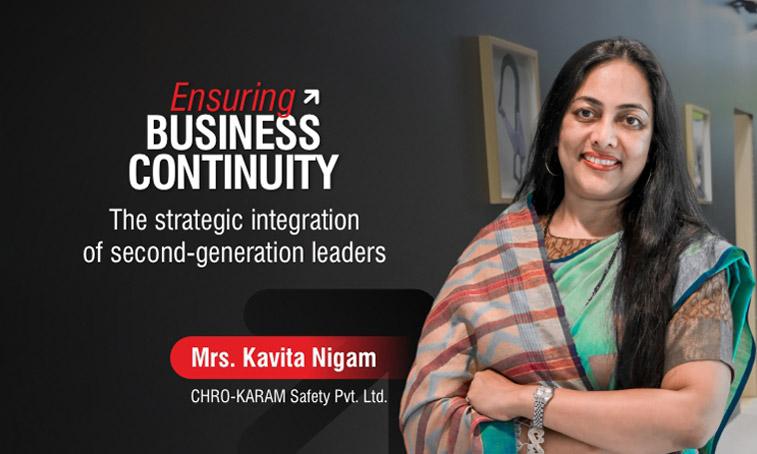
Ensuring Business Continuity: The strategic integration of second-gen leaders by Mrs. Kavita Nigam, CHRO
The Importance of Leadership
Family-owned businesses thrive on hard work and values, significantly contributing to industries and employment.
However, leadership transition is a critical moment. Without a deliberate strategy, businesses risk losing legacy.
Thoughtfully integrating second-generation leaders is about securing the future while honouring the business's past.
Preparing the next generation begins long before the leadership baton is passed. Early exposure to the business, perhaps even beginning with benign dining-table conversations, helps successors understand its culture, operational dynamics, and customer relationships. Involving the second-generation leaders in a more structured manner like internships, cross-departmental roles, and challenging projects cultivates their appreciation for every layer of the business. This not only builds competence but also earns them respect within the organisation. When employees see the successors’ willingness to learn from the ground up, it fosters trust and reinforces their credibility.
Blending tradition with innovation
Founders often have an instinctive, hands-on approach to decision-making, forged through years of navigating challenges. On the other hand, the next generation brings a different skill set, often shaped by global exposure, education, and digital fluency. Businesses must recognise the value of this diversity. Strategic integration involves creating spaces for dialogue where tradition and innovation meet. Second-generation leaders can introduce new technologies, sustainability practices, or business models while staying rooted in the company’s ethos. This combination allows the organisation to evolve without losing its identity.
Structured mentorship and knowledge transfer
Leadership transition should not be treated as a singular event but as a carefully managed process. Founders play a critical role as mentors, offering guidance and motivation while allowing successors to make independent decisions. A well-documented knowledge transfer plan including financial strategies, client relationships, operational processes, and crisis management protocols reduces dependence on a single leader. Formal governance structures, such as family councils or advisory boards, also provide a platform for transparent communication, ensuring alignment between family members and business objectives.
The value of external experience
Second-generation leaders benefit significantly from external exposure before assuming leadership roles. Work experience outside the family business helps them develop fresh perspectives, credibility, and resilience. Such an experience allows the next gen to empathise with the employees, having had an exposure as themselves being employees. It also builds confidence among the team who often expect leaders to bring in best practices from diverse environments. This external lens can be instrumental in identifying growth opportunities, modernising systems, and implementing scalable solutions.
Building a culture of stewardship
Family-owned businesses thrive when successors view themselves not merely as heirs but as stewards of a legacy. Instilling this sense of stewardship requires deliberate conversations about the company’s founding values, long-term goals, and social impact. A culture of stewardship encourages leaders to focus on sustainability rather than short-term gains, enabling businesses to adapt to changing market dynamics while safeguarding the founder’s vision.
The integration of second-generation leaders is a defining moment that shapes a family business’s future. It is not only a leadership shift but a strategic evolution that demands thoughtful planning, mutual respect, and open-mindedness. Founders must create opportunities for successors to gain hands-on experience and autonomy, while successors should embrace the responsibility of innovation and growth. When executed with care, guidance and an occasional pat-on-the-back by the founders, this transition becomes more than a handover; it becomes a renewal of purpose, ensuring that the family’s values and entrepreneurial spirit continue to thrive for generations to come.
Share:
Subscribe to Our Newsletter
To get latest updates about products, services and news & events subscribe below
Company Details
Learn more about us.

Contact Address
D-95, Sector 2, Noida

Email Address
karam@karam.in

Contact Number
1800-103-7085